Lukas Madl
How can knowledge of urban soils be integrated into renaturation practices?
Towards a tool to assist decision-makers and practitioners
Over the last few decades, urban populations have grown significantly, and this trend is set to continue, with 68% of the world's population living in cities by 2050 (Eurostat, 2022; United Nations Department of Economic and Social Affairs, 2019). At the same time, cities often expand into their outskirts, a phenomenon known as urban sprawl. The creation of housing and new economic, commercial and industrial activities is very often accompanied by the consumption of ‘unartificialised’ land, and therefore the transformation of natural, forest or agricultural areas into urbanised or ‘artificialised’ areas (Decoville and Feltgen, 2023). However, this massive urbanisation causes serious environmental problems, such as soil degradation, biodiversity loss and the exacerbation of climate change (IPBES, 2019, 2018; Zhan et al., 2023).
Faced with these challenges, it is becoming imperative to transform urban development strategies by integrating principles of densification, green infrastructure and synergy between these elements, underpinning the ‘compact city’ model (Artmann et al., 2019). Urban green spaces, in particular, play a crucial role in these strategies, as they provide ecological services to mitigate environmental impacts and improve the quality of life for city dwellers (Busca and Revelli, 2022).
However, improving urban ecosystems, especially in heavily degraded areas, remains a major challenge, mainly due to often very hostile environmental conditions. Soils have long been neglected in urban planning and ecological restoration projects (Farrell et al., 2020; Landauer, 2019). Yet improving soils plays a central role, as they are at the heart of any functional ecosystem and provide multiple ecosystem services. Consequently, recognition of the multifunctional role of soils and their finite nature as a resource is now at the centre of environmental debates and European public policy (European Commission, 2023, 2021).
In the effort to respond to ecosystem degradation, renaturation is a term whose use is increasing exponentially. Its definition remains vague, but it seems to embody a wide range of urban development operations aimed at creating green spaces in cities. There has been a paradigm shift in the implementation of these projects, with greater importance being placed on soils and their ecological functions in project design. This development has been accompanied by an increase in the number of studies focusing on the integration of soil science knowledge into renaturation projects (Blanchart et al., 2018; Deboeuf de Los Rios et al., 2022; Monfort et al., 2019; Schwartz et al., 2024, 2022; Taugourdeau et al., 2020). Nevertheless, scientific work dealing at the operational level with the adaptation of renaturation methods and techniques to local conditions is rare.
This thesis seeks to contribute to the gathering of knowledge on this subject through several stages. First, the concept of renaturation will be examined through its definitions and the associated and recommended measures. Next, several French case studies will be used to analyse the factors that influence the choice of renaturation measures implemented; how stakeholders navigate the obstacles they encounter; and the extent to which ecological knowledge about soils informs the planning and implementation of renaturation. The results will be used to develop recommendations for project owners and contractors to best adapt future renaturation projects to local conditions, minimise negative impacts on the environment, and maximise positive effects on fauna and flora.
–
Doctoral framework
◖ Thesis supervisor
Youssef Diab
(HDR) Lab'Urba
Mathieu Delorme
(co-supervisor) OCS Laboratory
◖ Affiliated institutions
01.2024-ongoing
CIFRE contract thesis at AREP
◖ Research environment
OCS Laboratory
Lab'Urba
–
–
About the research
◖ Keywords
Renaturation, soil refunctionalisation, SUITMA, ecological knowledge of soils, land use
◖ Scientific posters
- Research Days

View large poster
- Soil Study Days
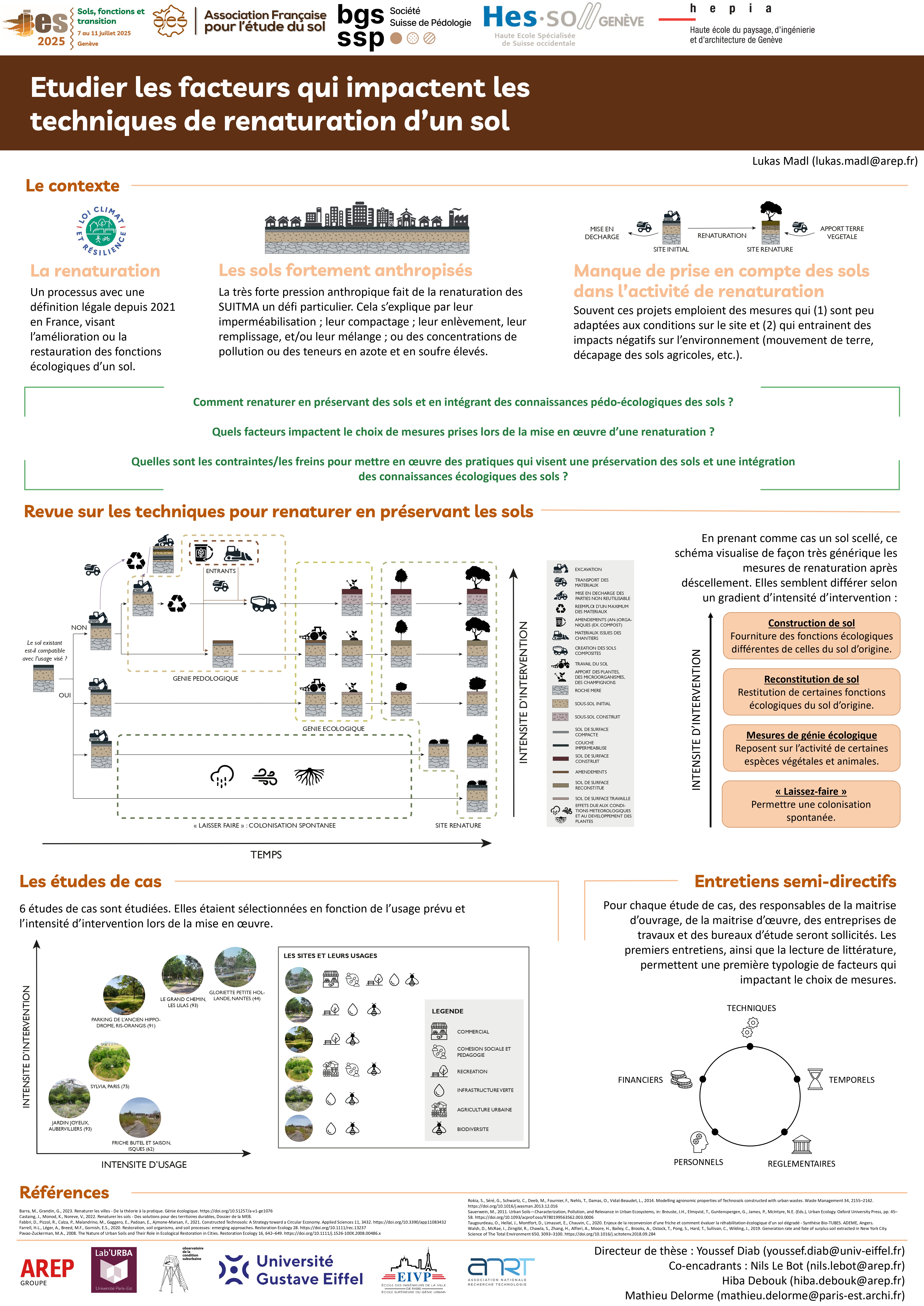
View large poster
◖ Bibliography
See bibliography →
–
Illustration →
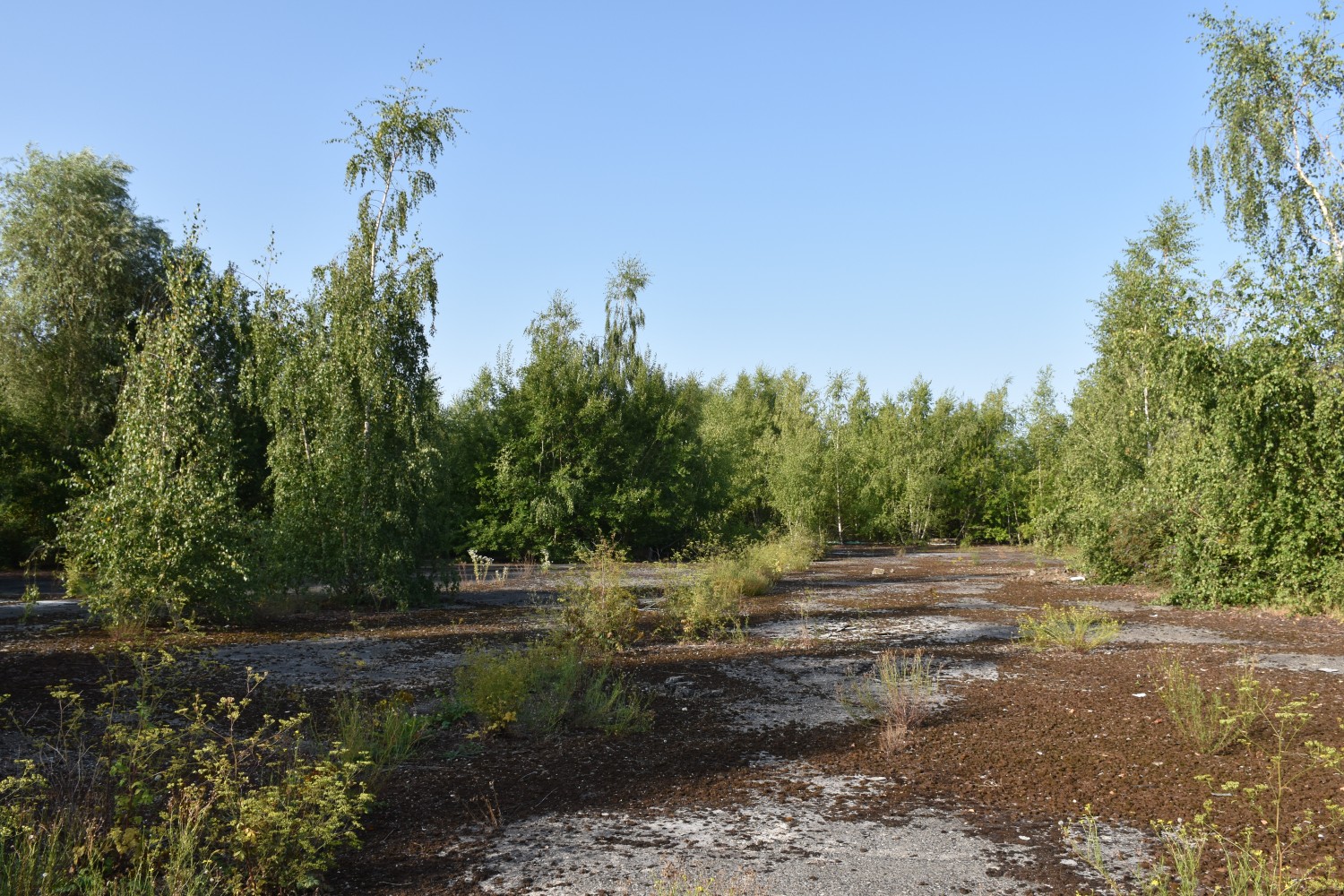
Photograph by Lukas Madl