Public policies
The school has over 20 years’ experience in supporting public policy through the design of projects aimed at transforming our built environments, at the intersection of territorial, urban and architectural scales: a rapidly changing coastline, a polluted and neglected moorland, a congested road, a run-down town centre, a dilapidated or abandoned building, etc.
In practical terms, Ensa Paris-Est develops close collaborations with public, semi-public and private organisations, in the form of commissions, research projects or bespoke partnerships.
The school’s expertise is underpinned by the involvement of students supervised by a teaching team that combines practice and research. This leads to the development of regional, urban planning and/or architectural projects spanning one or more semesters, in constant interaction with the study sites and clients. As a result, clients see their challenges become more complex, take new directions and be precisely spatialised.
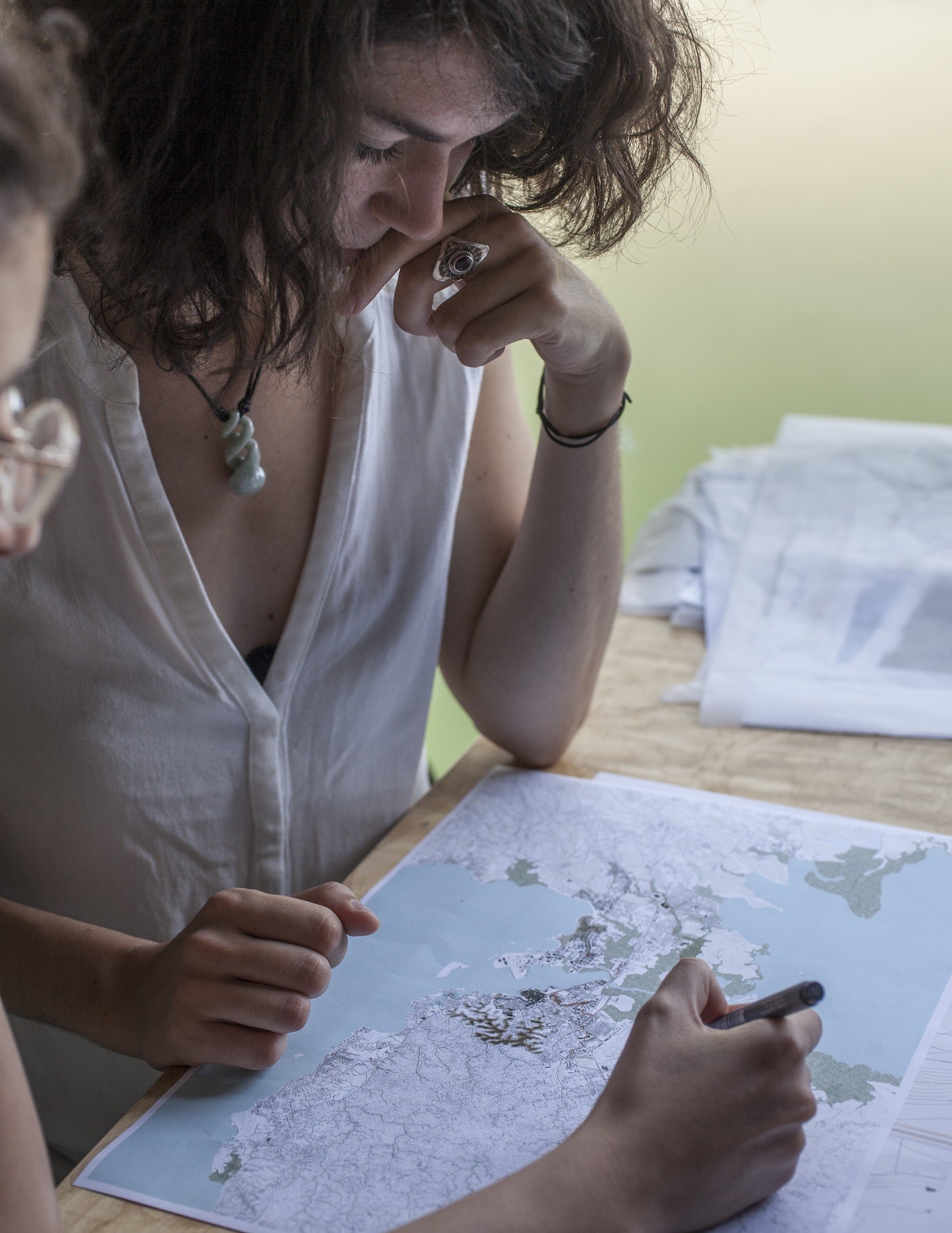
Field surveys and meetings with local stakeholders and users enable the production of analyses, hypotheses and various scenarios for spatial transformation in response to the issues raised by the client. The outputs are always collaborative and well-documented. The deliverables take the form of models, maps, analyses and photographic reports, and may even include editorial booklets, conference debates and exhibitions.
Work with our students
Depending on the client’s needs, the school engages undergraduates, Master’s students, post-Master’s students, or even research teams specialising in scientific topics.
Bachelor’s degree
Territorial studies
· aim: an intensive, week-long immersive study focusing on a territorial issue proposed by a client
· Teaching approach: a cohort of around 100 second- or third-year Bachelor’s students supervised by five lecturers
· Recent examples: Étang de Berre, a coastal saltwater lagoon between Marseille and the Fos-sur-Mer industrial and port complex
Project Studios
· Aim: development of an architectural project based on an issue proposed by a client
· Teaching structure: 20 third-year Bachelor’s students supervised by one lecturer
· Examples: housing, public facilities
Master’s
Depending on the nature of the client’s brief, the partnership involves one or more of the school’s four Master streams: Architecture and Experience, Fragments, Element, Structure & Architecture, and Transformation
· Duration: one semester or a full academic year
· Recent example: the Transformation programme in the Ardennes, the Pyrénées-Orientales Regional Nature Park, and the Yonne Departmental Directorate for Territorial Development (DDT)
Post-Master’s DSA in Architecture and Urban Planning
As part of the DSA in Architecture and Urban Planning, young architects and landscape architects carry out forward-looking studies commissioned by local authorities, public institutions or private organisations. These studies closely combine analysis and proposals at various scales: from the wider landscape down to architectural or public space projects. They are situated in urban, peri-urban and rural areas alike and cover a wide range of subjects that often intersect several themes: infrastructure/mobility, tourism, risks, heritage, urban regeneration, city/nature, etc.
Post-Master’s Programme in Architecture of Planetary Limits
The ALP post-master’s programme has a forward-looking and exploratory nature that combines architecture with technical analysis. The latter focuses on acquiring the tools for analysing and implementing case studies from the world of construction.
Projects involve collaboration between the school and external partners from the client sector, construction companies and manufacturers, or project management firms.
· Recent examples: the Palais du Rhin in Strasbourg / Drac Grand-Est; the greenhouses at the City of Paris School of Horticulture / École du Breuil
Research
The school’s research activities are organised around chairs and thematic networks, in partnership with institutional, academic or socio-economic stakeholders
· Chair in Land Use Transition
· Chair in The Coast as a Project Territory
· ‘Architecture and Transformation’ network
· ‘Rural Perspectives’ network
Terms and Funding
Each collaboration is governed by a partnership agreement setting out the objectives, the scope of the study, the timetable and the expected deliverables.
Clients are involved in interim and final review meetings.
The deliverables are intended to support strategic thinking and public decision-making. They have no operational value.
Costs and financial arrangements are determined on a case-by-case basis, depending on the nature of the commission, its duration and the number of research teams involved.
Depending on the nature of the project and the partner, some commissions and projects are carried out without financial compensation; others may qualify for sponsorship or research tax credits.
Recent examples
Framework agreement with the Ardennes Departmental Directorate for Territorial Development (DDT)
In February 2025, Ensa Paris-Est and the Argonne Ardennaise Community of Communes, on behalf of the Crêtes Pré-ardennaises and Ardennes Thiérache Communities of Communes, signed a framework agreement to support public policy, in partnership with the Ardennes DDT.
Over a period of 18 months, students carried out studies on regional attractiveness, support for the implementation of the ZAN (Zero-Growth Area) and the revitalisation of town centres. The partnership involved over a hundred students across several programmes: the post-master’s DSA in Architecture and Urban Planning, the DPEA in Architecture of Planetary Limits, the Master’s (Transformation specialisation), and the Bachelor’s degree.
Post-Master’s projects
Visit ici to view the publications of the latest studies carried out by students on the DSA in Architecture and Urban Planning and the DPEA in Architecture of Planetary Limits (formerly POCA).
Contacts
Marion Leclercq
Head of Development
Yana Boutoille
Head of Sponsorship and Partnerships
Publications
Cahiers du DSA
Find out more
Appui aux politiques publiques Université Gustave Eiffel
Photo
© Myr Muratet