Conférence sur l'intelligence artificielle
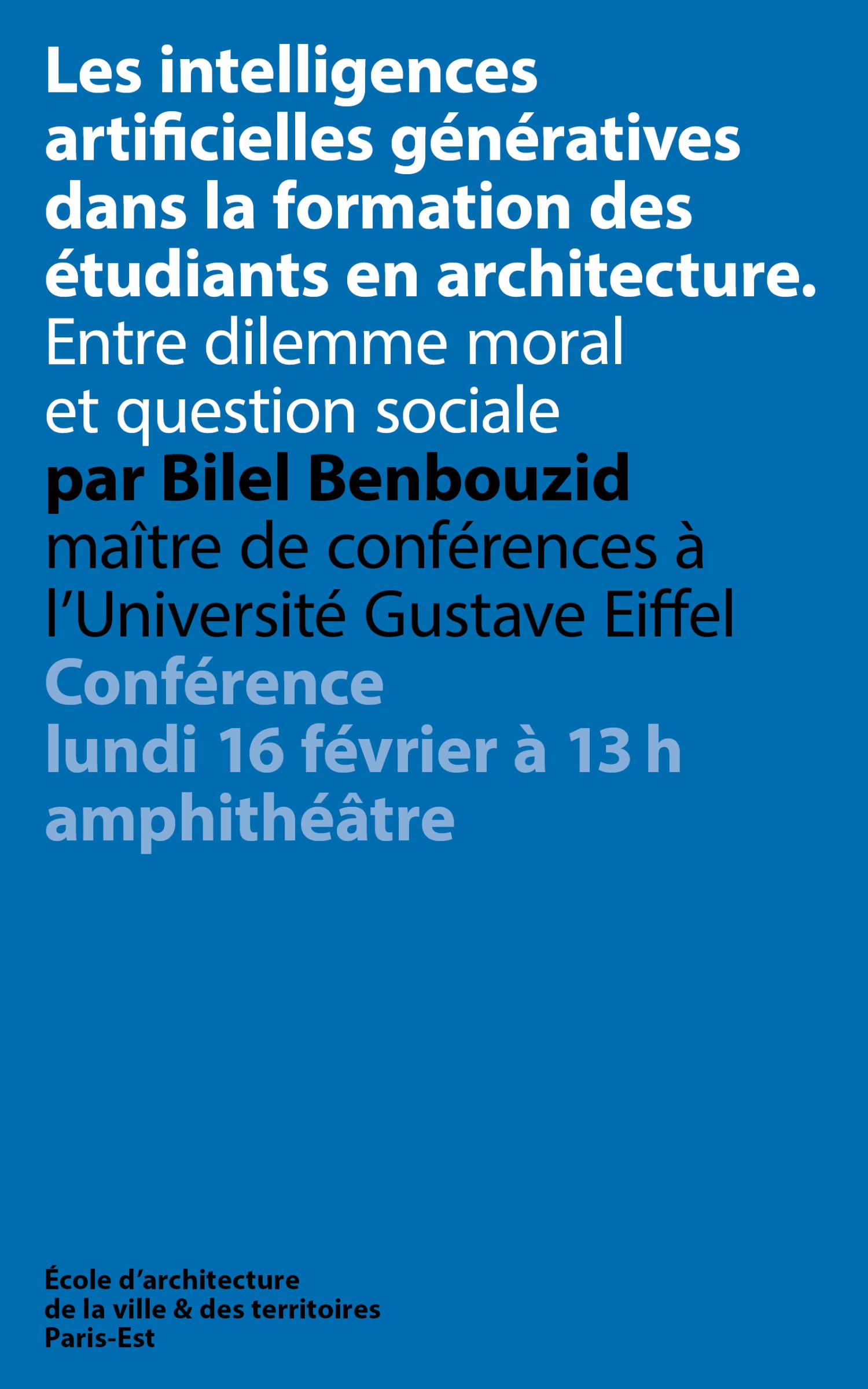
IAGs in the training of architecture students: between moral dilemma and social issue by Bilel Benbouzid
lundi 16 février 2026à 13:00
Amphithêatre
The introduction of generative artificial intelligence into higher education represents a genuine tipping point that is shaking the traditional foundations of academic ethics. This major transformation calls into question three essential pillars of the academic ecosystem: scientific integrity, authenticity and intellectual autonomy.
In the face of these technologies, traditional normative benchmarks are losing their prescriptive force. Academic integrity is being put to the test by the practical impossibility of clearly distinguishing between passive and active use of generative AI, rendering the classic notions of plagiarism and cheating obsolete. An architectural project can now be formally original whilst being fraudulent, as it is not authentically produced by its declared designer. This ambiguity reveals that the problem goes beyond the simple opposition between good and bad use to question the very nature of legitimate intellectual endeavour.
The issue of authenticity thus takes on a new dimension. In a world where architectural designs can be produced in collaboration with image-generating machines, a hybrid subjectivity emerges, comparable to Donna Haraway’s concept of the cyborg. This new form of authenticity no longer lies in the project’s pure origin, but in the ability to understand and shape the design mechanisms shared between human and machine. AI systems function as implicit co-designers who subtly guide spatial forms, raising the fundamental question of what constitutes authentic self-expression in this technological context.
Autonomy, an ethical pillar of higher education, is also being redefined. Some philosophers propose an ethics of non-use based on the moral obligation to cultivate one’s own capacity for reflection and judgement. For them, delegating design to an AI amounts to relinquishing the very faculties that make autonomy possible. But there is a tension between autonomy as an educational end and autonomy as freedom of choice, which encapsulates the contemporary dilemma regarding AGIs.
But this tension also raises the question of ‘who actually has the freedom to choose not to use them?’. For this freedom of non-use itself becomes a social privilege, revealing that behind the apparent levelling of performance lies a deeper structural inequality. Those who have the best grasp of visual standards and architectural vocabulary are the most advantaged. Whilst they appear to standardise access to representational skills, CGI actually reinforces existing hierarchies between young apprentices and the architectural elite.
Bilel Benbouzid is a senior lecturer in sociology at Gustave Eiffel University and a researcher at LISIS (Interdisciplinary Laboratory for Science, Innovation and Society). His research focuses on the sociology of science and technology as applied to digital platforms, algorithms and artificial intelligence.
Analysing the social implications of AI, in 2013 he created the first French master’s degree combining social sciences and artificial intelligence. He has led several research projects on the economics of audiovisual platforms and predictive systems, and is currently preparing a HDR on the regulation of artificial intelligence. His recent work examines the transformations in university practices in the era of generative AI.
Practical information
Lecture on Artificial Intelligence
1.00–2.30 pm in the lecture theatre
Free admission